
Quick answer (April 2026): $800/month is enough for most small tour operators to generate 20–30 direct bookings/month. Recommended budget split: 40% branded + competitor, 30% long-tail commercial, 20% remarketing, 10% discovery. Expect 5–6× blended ROAS once campaigns mature in 30–60 days. Plug in your budget for projected bookings →
Google Ads is the fastest way for tour operators to generate direct bookings because it reaches travelers who are actively searching for the exact tours you offer. Unlike social media ads where you're interrupting someone's browsing, Google Ads puts your tour in front of people at the moment they're ready to book. This guide covers the complete setup process with real budget examples.
Why Google Ads Works Better Than Social Media for Tour Bookings
The difference comes down to intent. A traveler searching "kayaking tour Dubrovnik price" has already decided they want a kayaking tour in Dubrovnik. They're comparing providers and prices. A Facebook ad shown to someone who liked a "Croatia Travel" page reaches someone who might visit Croatia someday.
Average conversion rates for tour-related Google search ads range from 3-8%, compared to 0.5-2% for social media ads. The cost per acquisition is higher per click, but the cost per actual booking is typically lower because the conversion rate is so much better.
Google Ads also provides immediate results. While SEO takes 3-6 months to build momentum, a properly configured Google Ads campaign can generate bookings within the first week of launching.
Campaign Structure for Tour Operators

The single biggest mistake tour operators make with Google Ads is throwing all their tours into one campaign with broad keywords. This wastes budget on irrelevant clicks and makes optimization impossible.
Recommended campaign structure:
Create one campaign per destination or tour category. Within each campaign, create separate ad groups for each specific tour or keyword theme.
Example structure for a Cozumel tour operator:
Campaign 1: Cozumel Snorkeling Tours
- Ad Group: "cozumel snorkeling tour" keywords
- Ad Group: "cozumel reef snorkeling" keywords
- Ad Group: "private snorkeling cozumel" keywords
Campaign 2: Cozumel Diving Tours
- Ad Group: "cozumel scuba diving" keywords
- Ad Group: "cozumel cenote diving" keywords
- Ad Group: "cozumel PADI certification" keywords
Campaign 3: Cozumel Fishing Tours
- Ad Group: "cozumel deep sea fishing" keywords
- Ad Group: "cozumel sport fishing charter" keywords
This structure lets you set different budgets per tour type, write highly specific ad copy for each keyword theme, and see exactly which tours and keywords generate the best return.
Tool: Plug your monthly budget and AOV into the free Google Ads Budget Allocator. It splits the spend across branded / long-tail / remarketing / discovery and shows projected clicks, bookings, and ROAS per bucket. Saves an hour of spreadsheet work.
Keyword Selection: Focus on High-Intent, Tour-Specific Terms
High-intent keywords include the tour type, destination, and often a buying signal like "price," "book," or "cost." This aligns with comprehensive keyword strategy for your overall tour operator marketing.
Examples of high-intent tour keywords:
- "snorkeling tour cozumel price"
- "book kayaking tour dubrovnik"
- "best food tour bangkok reviews"
- "private sunset cruise santorini cost"
- "family hiking tour zion national park"
Medium-intent keywords show interest but aren't as close to booking:
- "snorkeling in cozumel"
- "things to do in dubrovnik"
- "bangkok food experiences"
Low-intent keywords to avoid or bid very low on:
- "cozumel" (too broad)
- "is snorkeling hard" (informational, not buying)
- "dubrovnik weather" (planning stage, not booking stage)
Negative keywords are critical. Add these from day one:
- "free" (free tours, free snorkeling)
- "jobs" (tour guide jobs)
- "how to" (DIY, not looking for guided tours)
- "certification" (unless you offer certifications)
- "school" (academic searches)
- Competitor brand names (unless you're running competitor campaigns intentionally)
Writing Ad Copy That Converts for Tours
Tour-specific ad copy outperforms generic travel ad copy by a significant margin. The key is specificity. Price, duration, group size, and unique differentiators.
Generic ad copy (low conversion): "Amazing Tours in Cozumel - Book Your Adventure Today - Unforgettable Experiences Await"
Tour-specific ad copy (high conversion): "Cozumel Snorkeling Tour $89/Person - 3 Hours at Palancar & Colombia Reefs - Small Groups of 12 Max - Free Photos Included - Book Direct & Save"
The second ad converts better because it answers the traveler's key questions immediately: how much, how long, where exactly, how many people, and what's included.
Ad extensions to use:
Price extensions showing individual tour prices. Callout extensions highlighting "Direct Booking Discount," "Free Cancellation 24hr," "Small Groups Only," or "Certified Guides." Structured snippets listing tour types: "Tours: Snorkeling, Diving, Fishing, Sunset Cruise." Sitelink extensions pointing to specific tour pages, reviews page, and FAQ.
Landing Pages: Don't Send Traffic to Your Homepage
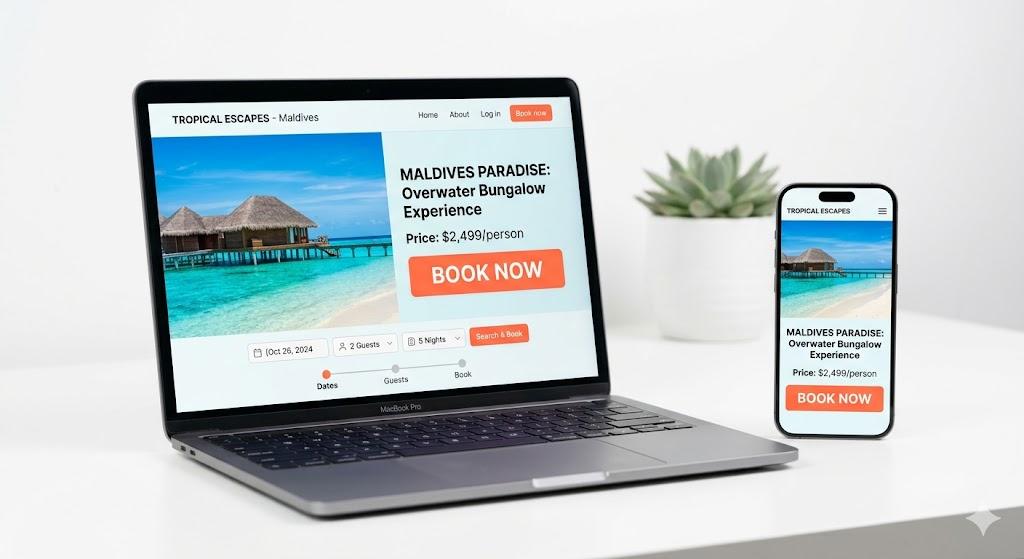
Every ad group should link to a dedicated landing page for that specific tour, not your homepage, not your general tours page, and not your "contact us" page. Optimizing checkout UX and landing page design is critical to converting Google Ads traffic into bookings.
A converting tour landing page includes:
Above the fold: Tour name, price, duration, a striking hero image, and a prominent "Book Now" button or calendar widget showing available dates.
Below the fold: Detailed itinerary, what's included/excluded, meeting point with map, group size, physical requirements, cancellation policy, and 5-10 guest reviews with star ratings.
Page speed matters enormously. A landing page that loads in 1 second has a 3x higher conversion rate than one that loads in 5 seconds. Compress images, use next-gen formats (WebP), and remove unnecessary scripts.
These are the same budget bands we use when scoping Google Ads for tour operators as a managed service, where Meta retargeting runs alongside Search to catch the guests who clicked but didn't book.
Budget Planning: Realistic Numbers for Tour Operators

Here's how to estimate your budget and expected returns.
For a small operator (1-3 tours, one destination):
Starting budget: $200/week ($800/month) Average CPC for tour keywords: $1.50 Weekly clicks: ~133 Conversion rate at 5%: ~7 bookings/week At $80 average booking value: $560/week in direct revenue Monthly: ~28 bookings, $2,240 revenue from $800 ad spend
That's a ~2.8x return on ad spend at this conservative-budget tier, and these bookings are commission-free. (For reference: PrimeOne Tours, our flagship case study, lifted direct bookings 127% in 12 months at 2.8× blended ROAS across Google and Meta, different vertical, different intent profile.) Plug your own numbers into the free tour ROI calculator to model the return on your ad spend before you scale the budget.
For a mid-size operator (5-10 tours, multiple destinations):
Starting budget: $500/week ($2,000/month) Average CPC: $1.50-$2.50 Weekly clicks: 200-330 Conversion rate at 5%: 10-16 bookings/week At $100 average booking: $1,000-$1,600/week Monthly: 40-64 bookings, $4,000-$6,400 from $2,000 spend
Seasonal budget adjustment:
Scale up during your peak season (2-3x your base budget) and scale down during off-season (0.5x base budget or pause). Understanding seasonal marketing patterns helps optimize your spend throughout the year. There's no point paying for clicks in January if your tours run May through October.
Optimization Checklist: First 30 Days
Week 1: Launch campaigns, monitor search terms report daily, add negative keywords aggressively. Don't change bids yet, let data accumulate.
Week 2: Identify which ad groups and keywords are generating clicks. Pause keywords with high clicks but zero conversions. Adjust bids up on high-converting keywords.
Week 3: Write A/B test ad variations for your top-performing ad groups. Test different prices, benefits, and calls-to-action. Enable enhanced conversions tracking if not already set up.
Week 4: Review the full month's data. Calculate cost per booking for each campaign and ad group. Shift budget from underperforming campaigns to top performers. Set up automated bid strategies (Target CPA) if you have 30+ conversions in the account.
Common Google Ads Mistakes Tour Operators Make
Running only broad match keywords. Broad match "snorkeling tour" shows your ad for "snorkeling gear review" and "free snorkeling beaches." Use phrase match and exact match for precise targeting.
Not tracking conversions properly. If you're not tracking completed bookings as conversions, Google's algorithms can't optimize your campaigns. Learn more about Google Ads setup on their support site. Set up conversion tracking through your booking system's confirmation page.
Sending all traffic to the homepage. Your homepage isn't designed to sell a specific tour. Build dedicated landing pages for each tour you advertise.
Ignoring mobile bid adjustments. Over 60% of tour searches happen on mobile. If your mobile booking experience is poor, reducing mobile bids and improving checkout UX can improve your overall return. Consider reducing mobile bids rather than wasting budget on clicks that won't convert.
Not using location targeting. If your tours are in Cozumel, target ads to travelers in the US, Canada, and Europe, not globally. You can also increase bids for searchers in cities with direct flights to your destination.
If managing campaigns yourself becomes a bottleneck, it may be time to bring in help. See our comparison of tour operator marketing agencies for how to evaluate specialists on Google Ads fluency and direct-booking reporting before you sign anything, or look at our own done-for-you tour operator Google Ads service.