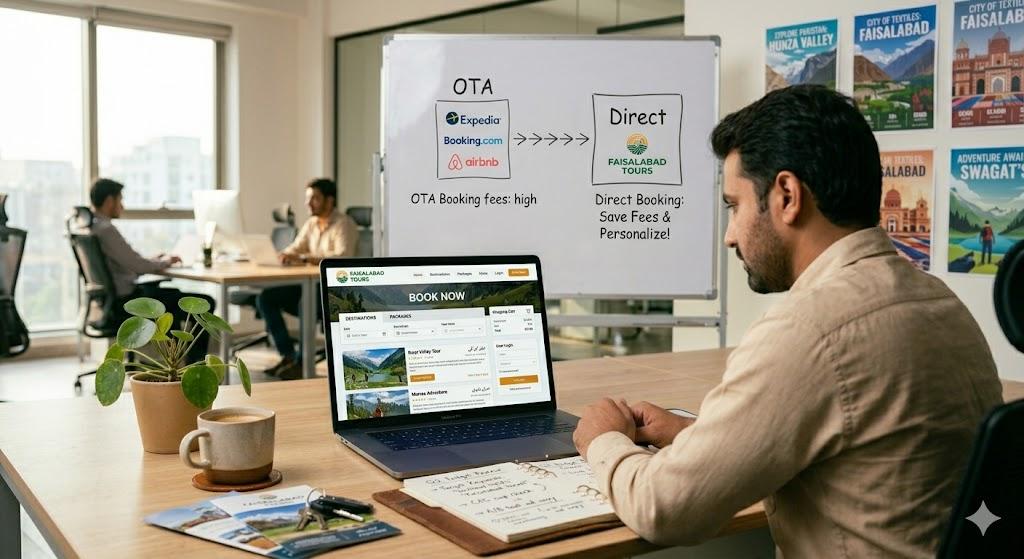
Quick answer (April 2026): Most tour operators pay 20–25% commission to Viator and GetYourGuide. Shifting 30% of OTA bookings to direct typically saves $26K–$80K/year. The 5-step plan: (1) direct booking website, (2) post-tour email capture, (3) Google Ads on branded queries, (4) review-driven referrals, (5) repeat-guest discounts. Calculate your exact OTA spend →
Tour operators pay 20-25% commission on every booking through OTAs like Viator, GetYourGuide, and TripAdvisor Experiences. For a $100 tour, that's $20-$25 going to the platform instead of your business. This guide walks through the specific steps to shift 50-70% of your bookings to direct channels while keeping OTAs as a strategic acquisition tool.
Why OTA Dependency Is Dangerous for Tour Businesses
OTAs serve a purpose: they put your tours in front of travelers who don't know you exist yet. According to Phocuswright's research on travel trends, the problem starts when 70-90% of your bookings come through OTAs, which is common for operators who haven't invested in their direct booking channel.
The math is straightforward. A tour operator doing $300,000 in annual revenue with 80% OTA bookings at 22% average commission pays roughly $52,800 in fees. Shifting to 50% direct bookings saves over $26,000 per year, money that goes directly to your bottom line.
Tool: Calculate your specific number. Plug your annual revenue, OTA share, and commission rate into the free OTA Commission Calculator. It also models the savings of shifting X% to direct, plus payback math on a website + marketing investment. To pressure-test the return on that marketing spend, run the tour ROI calculator as well.
Beyond commissions, OTA dependency creates three business risks. First, you don't own the customer relationship. The OTA does. You can't email past guests about new tours or seasonal offers. Second, OTAs control your pricing and visibility; algorithm changes can tank your bookings overnight. Third, your business valuation drops significantly when revenue is platform-dependent rather than self-generated.
Step 1: Build a Direct Booking Website That Converts
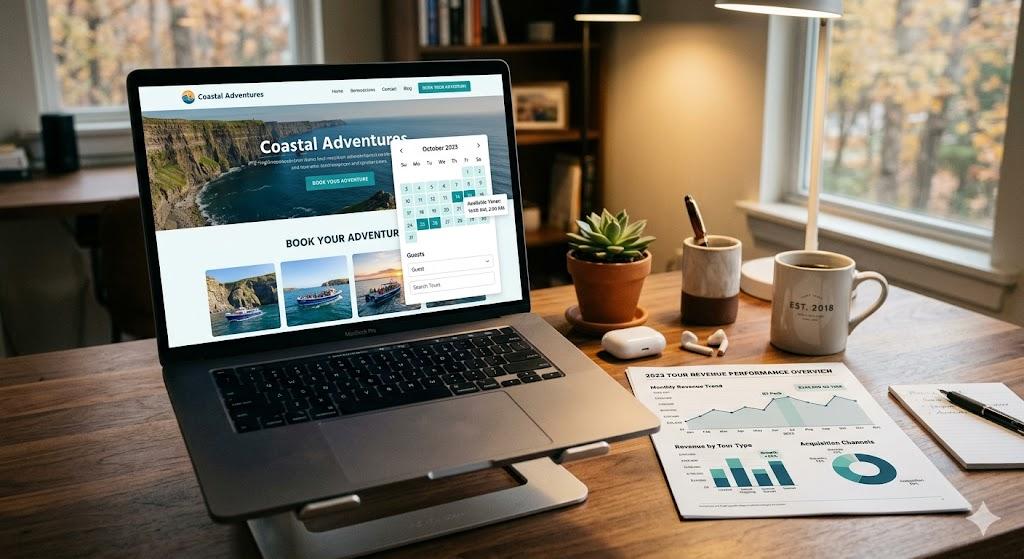
Your website is the foundation of direct booking revenue. Most tour operator websites fail at conversion because they're built like brochures rather than booking engines. If yours falls into that trap, our tour website design service builds sites engineered around the booking flow rather than the brochure.
What a converting tour website needs:
A clear booking widget above the fold on every tour page. Travelers should see the price, available dates, and a "Book Now" button within 3 seconds of landing on the page. Tools like Rezdy, FareHarbor, and Bokun offer embeddable widgets that handle real-time availability and payment processing, but their fee structures vary dramatically. Use the free Booking Fee Calculator to compare annual cost across all 6 major platforms for your specific volume.
Mobile-first design is non-negotiable. Over 60% of tour research happens on phones, and Google's mobile-first indexing means your mobile experience directly affects search rankings. Your booking flow should require no more than 3 taps from tour page to completed payment.
Trust signals placed strategically near the booking button: TripAdvisor review ratings, Google review scores, safety certifications, and real guest photos. Travelers making a $50-$500 purchase from an unknown operator need reassurance before committing their credit card.
Fast page load speed, under 3 seconds. Every additional second of load time reduces conversions by roughly 7%. Compress images, use a CDN, and avoid bloated WordPress themes with 30 plugins.
Step 2: Capture High-Intent Traffic with Google Ads
Google Ads is the fastest way to get direct bookings because you're reaching travelers who are actively searching for exactly what you offer.
Keyword targeting strategy for tour operators:
Start with high-intent, destination-specific keywords. "Snorkeling tour Cozumel" converts better than "things to do in Cozumel" because the searcher already knows they want a snorkeling tour. They just need to pick a provider. SEO and keyword strategy work together with paid ads to maximize visibility.
Structure your campaigns by tour type and destination. Each tour should have its own ad group with tightly themed keywords. For a Cozumel snorkeling operator, this means separate ad groups for "Cozumel snorkeling tour," "Palancar reef snorkeling," and "Cozumel private snorkel trip."
Use ad extensions aggressively: price extensions showing your tour cost, callout extensions highlighting "Direct Booking Discount" or "Free Cancellation," and structured snippets listing tour features.
Budget allocation guidance:
Start with $200-$500 per week to generate enough data for optimization. At an average cost-per-click of $1-$3 for tour-related keywords and a 5% conversion rate, a $500/week budget can generate 8-25 direct bookings per week. Scale the budget during peak season and pull back during off-season.
Step 3: Offer a Direct Booking Incentive
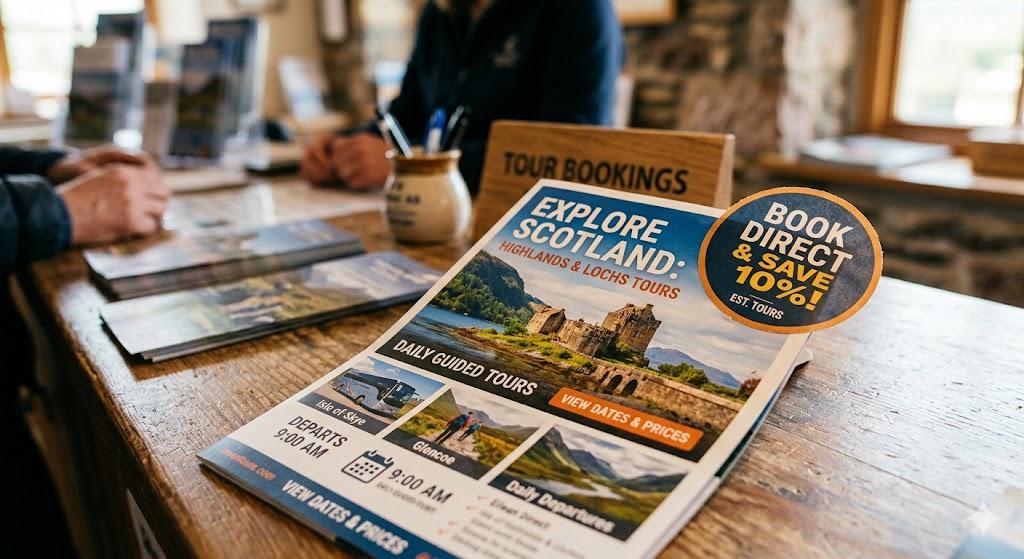
Give travelers a concrete reason to book directly rather than through an OTA. This doesn't mean undercutting your OTA price (which violates most OTA agreements). It means adding value to the direct booking experience.
Incentives that work for tour operators:
A direct-booking-only benefit like a free photo package, complimentary drink, or upgraded equipment. This adds perceived value without violating OTA rate parity.
"Book Direct" discount codes distributed through your email list, social media, and Google Ads landing pages. A 10% discount on a $100 tour costs you $10 but saves you $12-$15 in OTA commission. You come out ahead.
Flexible cancellation policies that are more generous than OTA terms. Many travelers choose direct booking specifically for better cancellation flexibility, especially for weather-dependent tours.
Early access to new tours or special time slots reserved for direct bookers.
Step 4: Implement Email Remarketing for Abandoned Bookings
Industry data shows that 60-70% of tour booking processes are abandoned before payment. Email remarketing recovers a meaningful percentage of these lost bookings.
Setting up abandoned booking recovery:
Integrate your booking system (Rezdy, FareHarbor, or custom) with an email platform like Mailchimp, Klaviyo, or ActiveCampaign. Trigger an automated email sequence when a customer starts but doesn't complete a booking.
The sequence should include three emails. The first, sent 1 hour after abandonment, is a gentle reminder with the tour name, date, and a direct link back to complete the booking. The second, sent 24 hours later, includes a guest testimonial or review specific to that tour. The third, sent 48 hours later, adds a small incentive like a 5% discount or free upgrade.
Average recovery rates for tour operators range from 8-15% of abandoned bookings, which translates directly to additional revenue at zero commission cost.
Step 5: Build a Past Guest Database
Every direct booking gives you something OTA bookings don't: the customer's email address and booking history. This data becomes your most valuable marketing asset.
What to do with your guest database:
Send a post-trip email 24-48 hours after each tour asking for a Google or TripAdvisor review. This builds social proof that drives more direct bookings.
Create seasonal email campaigns promoting new tours, special rates, or limited-time experiences to past guests. Return guest rates for tour operators average 5-15%, and these bookings are 100% commission-free.
Build a referral program offering past guests a discount on their next booking for every friend they refer. Word-of-mouth referrals have the highest conversion rate of any marketing channel.
The Realistic Timeline
Month 1: Launch or optimize your direct booking website, set up Google Ads with a $300/week budget, and implement abandoned booking email recovery.
Month 2-3: Direct bookings should represent 20-30% of total volume. Refine Google Ads targeting based on data, begin building your email list.
Month 4-6: Target 40-50% direct bookings. Scale ad spend during peak season, launch past guest email campaigns.
Month 6-12: Achieve 50-70% direct booking ratio with a mature email list, strong review presence, and optimized ad campaigns.
This isn't theoretical. Our PrimeOne Tours case study shows the same playbook in action: ~$1K/mo in ad spend driving ~$6K/mo in direct bookings placed off-site and off-Viator, at roughly 6× return on ad spend.
Keep OTAs: But on Your Terms
The goal isn't to abandon OTAs entirely. They remain valuable for reaching travelers in the research phase and for building initial reviews and visibility, especially for new tours. The goal is to make them a strategic acquisition channel (30-40% of bookings) rather than your primary revenue source.
Use OTAs for new tour launches to generate initial reviews and visibility. Use your direct channel for repeat bookings, high-margin private tours, and seasonal promotions. This balanced approach maximizes both reach and profitability.
If running this playbook in-house feels like too much, a specialist can execute it for you. Before you hire, read our honest comparison of tour operator marketing agencies, including what to look for and the red flags to avoid.