Reviews are the most powerful conversion driver for tour operators. A BrightLocal study found that 87% of consumers read online reviews for local businesses, and tours are an even more review-dependent purchase because travelers are spending money on an experience they can't see or try beforehand. Tour operators with strong review profiles on Google and TripAdvisor consistently outperform competitors in both organic search rankings and booking conversion rates.
Where Your Reviews Need to Be
Not all review platforms carry equal weight. For tour operators, these three platforms matter most, in order of importance:
Google Business Profile: Directly affects your Google search visibility. Tours with 50+ Google reviews and a 4.5+ average rating appear in Google's local pack and maps results, which drives significant direct traffic. Google reviews also appear in AI Overviews and Google's generative search results. Learn more about managing your Google Business profile.
TripAdvisor: Remains the dominant travel-specific review platform. Many travelers search TripAdvisor directly when choosing tours, and a high TripAdvisor ranking in your destination category drives substantial booking volume. TripAdvisor reviews also appear in OTA search results across Viator (owned by the same parent company). Set up your TripAdvisor business profile to manage your reviews and business information.
Your own website: Displaying reviews directly on your tour pages is critical for converting the traffic you've already captured. Embed Google or TripAdvisor review widgets, or display curated testimonials with attribution (guest name, tour date, and tour name).
The Systematic Review Collection Process

Relying on guests to leave reviews voluntarily produces a 3-5% review rate. A structured collection process increases this to 15-25%.
Step 1: Ask at the moment of highest satisfaction. The best time to request a review is immediately after the tour ends, while the experience is fresh and emotions are positive. Train your guides to make a brief, genuine ask during the wrap-up: "If you had a great time today, leaving a Google review helps other travelers find us."
Step 2: Follow up by email within 2 hours. Send an automated email with a direct link to your Google review page. Don't ask them to review on multiple platforms. Pick one primary platform (Google) and make it a one-click process. Well-crafted follow-up email sequences can significantly increase review rates.
The email should be short: "Thanks for joining us on [Tour Name] today! If you'd like to share your experience, here's a quick link: [Direct Google Review Link]." Include one specific photo from today's tour if possible. Seeing themselves in the photo triggers positive memories and motivates them to write. The free review request generator will write this ask for you in the right tone for your tour.
Step 3: Send a follow-up to non-reviewers after 3 days. For guests who didn't respond to the first email, send one more with a specific prompt: "What was the highlight of your [Tour Name] experience?" Giving a specific question makes writing a review easier.
Step 4: Respond to every review within 24 hours. Respond to positive reviews with personalized thanks that mention something specific about their tour. Respond to negative reviews professionally, acknowledging the issue and describing how you've addressed it. Your response is read by future travelers, not just the reviewer.
Handling Negative Reviews
Negative reviews are inevitable and actually beneficial in moderation. A tour profile with 100% five-star reviews looks fake. A mix of 4.5-4.8 average with a few lower ratings appears authentic.
When you receive a negative review:
Respond within 24 hours. Acknowledge the specific complaint without being defensive. Describe any corrective action you've taken. Invite the guest to contact you directly to resolve the issue.
Example response: "Thank you for your feedback about the wait time at the start of the tour on March 5. You're right that we started 20 minutes late due to a transport issue, and I understand that's frustrating. We've since arranged backup transport to prevent this in the future. I'd like to make this right. Please reach out to me directly at [email] so we can discuss."
This response shows future readers that you take complaints seriously and act on them, which actually increases trust.
When to dispute a review: Only dispute reviews that violate the platform's review policies: reviews from people who didn't actually take your tour, reviews with factual lies, or reviews that contain personal attacks. Don't dispute reviews simply because they're critical.
Leveraging Reviews Across Your Marketing
Reviews collected on Google and TripAdvisor should be repurposed across every marketing channel:
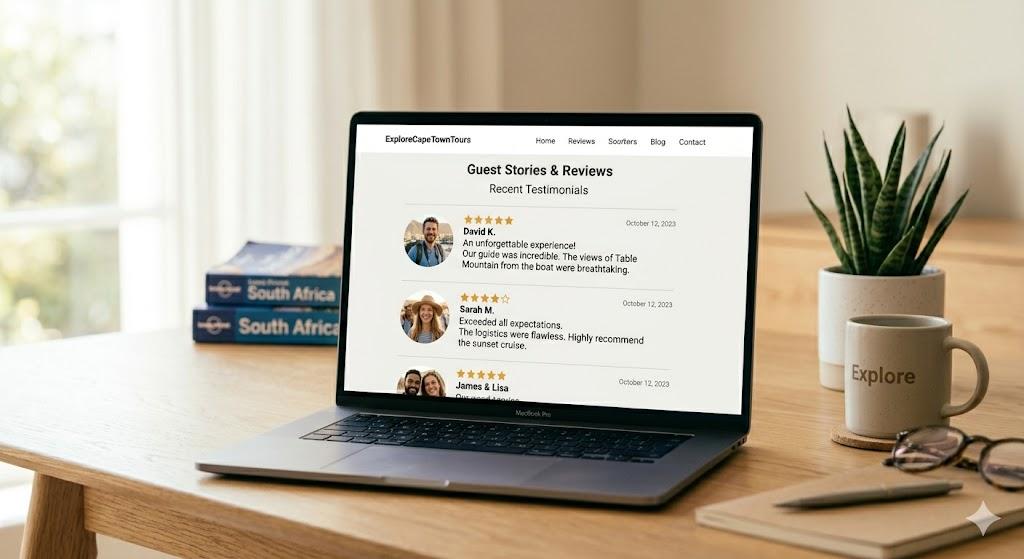
On your tour pages: Display 5-8 reviews directly on each tour listing page, near the booking button. Rotate reviews to show variety: different nationalities, group types (couples, families, solo travelers), and seasons. Include the reviewer's rating and date.
In your Google Ads: Use review extensions and callout extensions that reference your review profile. "Rated 4.8/5 on Google (200+ Reviews)" in your ad copy increases click-through rates.
In your email marketing: Include a review quote in your abandoned booking recovery email. A 5-star review from a real guest addresses the trust gap that caused the abandonment. Reviews that highlight value perception and pricing are especially effective at recovering abandoned bookings.
On social media: Share standout reviews as graphics with a photo from the tour. Tag the reviewer if possible. It creates organic reach and shows that real people love your tours.
Review Schema Markup for Your Website
Adding AggregateRating schema markup to your tour pages can display star ratings in Google search results, increasing click-through rates by 15-25%. This works alongside your broader SEO keyword strategy to drive organic visibility.
For this to comply with Google's guidelines, the reviews must be collected on your own website or a recognized third-party platform, and the aggregate rating must be accurate. Don't fabricate numbers. Use real data from your Google Business profile or a verified review widget.
If you embed a TripAdvisor or Google review widget on your page, you can reference those ratings in your schema. The key requirement is that the reviews are verifiable and the numbers are accurate.
Building Reviews for New Tours
New tours face a cold-start problem, no reviews mean lower conversion rates, which means fewer bookings, which means slower review accumulation.
Strategies to accelerate reviews on new tours:
Run the first 2-4 weeks at a 20-30% launch discount with a clear expectation: "We're offering a launch price for our new [Tour Name]. In return, we'd love your honest review to help future travelers." This is explicitly allowed on Google (unlike paying for reviews, which is prohibited).
Invite local travel bloggers, hotel concierge staff, and tourism board representatives to experience the tour and provide public reviews. These carry extra weight because they're from recognizable sources.
Cross-promote from your established tours. If guests who took your popular snorkeling tour also book your new diving tour, their review carries the implicit endorsement of a repeat customer. Reducing reliance on OTA commissions through direct bookings means more opportunities to systematically collect reviews from your own guests.
Review Metrics to Track Monthly
Review velocity: How many new reviews are you receiving per week? Aim for a consistent flow rather than bursts. Google's algorithm favors businesses that receive steady, ongoing reviews over those that get 50 reviews in one week and then nothing for months.
Average rating by tour: Track each tour's average rating separately. A tour consistently below 4.5 stars needs operational improvement, not more marketing.
Review response rate: What percentage of reviews receive a response from you? Target 100% for negative reviews and 80%+ for positive reviews.
Review-to-booking ratio: Divide monthly reviews by monthly bookings. A healthy ratio is 15-25%, meaning 1 in 4-7 guests leaves a review.
Getting reviews is half the job; putting that social proof to work on your booking pages is the other half. Our booking optimization service places review snippets and trust signals where they lift conversions most.