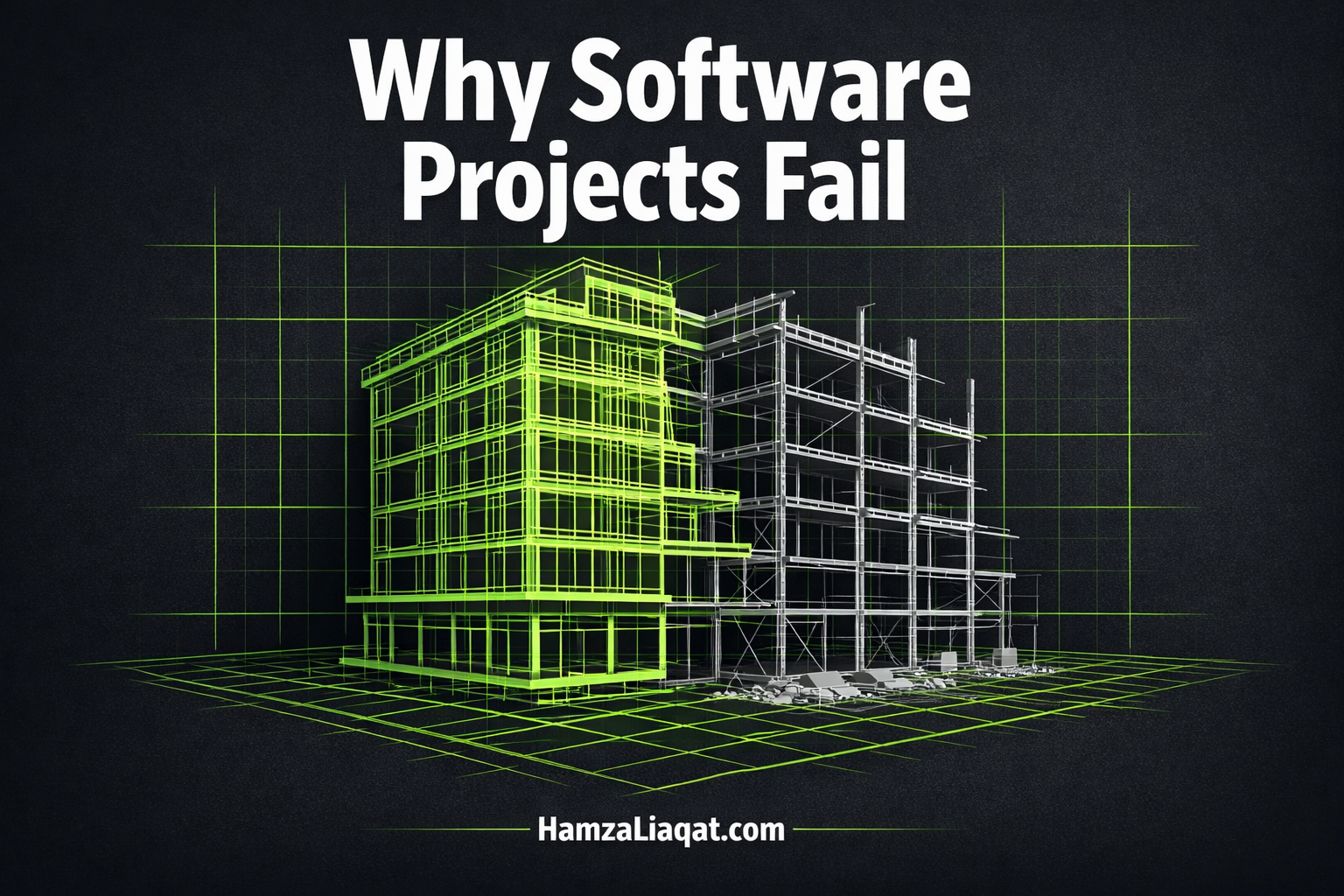
Code is the Easy Part. The Business Logic is Hard.
As a Production Architect, I've learned that your Build Engine is only as powerful as the strategy behind it. Most software projects don't fail because of bad code—they fail because developers, brilliant as they may be, misunderstood the business problem they were supposed to solve.
At Aryzetech, our Build Engine combines top-tier technical execution with deep business strategy. This isn't about just writing code; it's about engineering a production system that solves real problems for real users. The data is clear: a Harvard Business Review study found that 75% of venture-backed startups fail, and the number one reason isn't technical glitches—it's "no market need." The code works flawlessly, but the product is a perfect solution to the wrong problem.
The "Feature Creep" trap that kills budgets
Ah, feature creep. It's the silent killer of software projects, and it's dangerously seductive. It starts with a simple, innocent thought: "While we're building the login system, let's just add social authentication. And password recovery. Oh, and two-factor authentication. And why not biometric login?"
Individually, each of these additions seems perfectly reasonable. But collectively, they're a recipe for disaster, doubling your timeline and blowing up your budget.
The Feature Creep Cycle:
I've seen this play out so many times, it's like a predictable script:
-
Initial Scope: Everyone's excited. The core features are defined, the budget is allocated, and the timeline is set.
-
Mid-Project Additions: The "quick wins" and "nice-to-haves" start to sneak in during development.
-
Timeline Slip: The original deadline comes and goes. The team needs an extension.
-
Budget Overrun: More features mean more resources, and the costs start to spiral.
-
Quality Compromise: To try and meet the new deadline, testing and polish get sacrificed.
-
Launch Failure: The product finally ships—late, over budget, and riddled with bugs.
The root cause here is a lack of disciplined prioritization. When you're building your dream product, every feature feels essential. But your users don't care about your long list of features. They care about one thing: does your product solve their problem?
The Aryzetech Prioritization Framework:
To combat this, we use a simple but powerful framework that forces tough decisions early on:
-
Must-Have: These are the features that are absolutely essential for the product to function. Without them, there's no product.
-
Should-Have: These features would significantly improve the user experience, but they're not deal-breakers.
-
Nice-to-Have: These are the features that could differentiate you from the competition, but they can wait for version 2.
-
Won't-Have: These are the features that sound cool but don't actually serve the core use case.
This framework isn't about limiting your vision; it's about strategic focus.
Let me give you a real-world example from a recent SaaS dashboard project.
The client came to us with an initial feature list that had 47 features across 8 different modules.
After running it through our prioritization framework, we narrowed it down to 12 Must-Have features and 8 Should-Have features. The other 27 were moved to the post-launch roadmap.
The result? We shipped their MVP in 4 weeks instead of the originally estimated 16. They were able to get their product into the hands of real users and validate their core idea before spending a dime on the "nice-to-haves."
And the best part? Half of the features we cut were never even requested by users after launch. The other half were eventually implemented, but based on actual usage data, not just assumptions.
The Budget Reality:
It's crucial to remember that every feature has a cost that goes far beyond the initial development:
-
Testing time (which can be 2-3 times the development time for complex features)
-
Documentation and training
-
Ongoing maintenance and bug fixes
-
Technical debt that will slow down future development
A feature that seems like a quick 1-week build might actually end up costing you 4 weeks of total project time. Feature creep doesn't just delay your launch; it exponentially compounds the complexity of your project.
The solution is ruthless prioritization. Build the absolute minimum viable product that solves the core problem. Ship it. Learn from real users. And then, and only then, build version 2 based on data, not just a hunch.
Why you need a technical partner, not just a coder
The difference between a coder and a technical partner is like the difference between a hammer and a carpenter. One is a tool that executes instructions. The other is a craftsman who solves problems.
What Coders Do:
-
Implement features exactly as they're specified
-
Write clean, functional code
-
Meet the technical requirements
-
Deliver on time and on budget
What Technical Partners Do:
-
Challenge your feature requirements before a single line of code is written
-
Suggest alternative approaches that could save you time and money
-
Identify potential technical risks early on
-
Align every technical decision with your business goals
Most founders I meet don't need more code. They need strategic guidance on what to build and how to validate it as cheaply as possible.
The Technical Partner Value Proposition:
-
Pre-Development Validation: Before we even think about writing code, we validate the idea with prototypes, user interviews, and market research. This is how we prevent you from building the wrong thing perfectly.
-
Architecture for Scale: We design systems that can handle 10 users today and 10,000 users tomorrow without needing a complete rewrite.
-
Technology Selection: We help you choose the right tools for your specific use case, not just the trendy new framework that will be obsolete in two years.
-
Risk Mitigation: We identify technical, security, and scalability risks before they turn into expensive, project-killing problems.
At Aryzetech, our first conversation with a new client is never about technology. It's about their business model, their target users, and their metrics for success. The technical decisions flow from the business requirements, not the other way around.
Let me share a story from a fintech startup we worked with.
The founder came to us with a request: "Build a mobile app with blockchain integration for peer-to-peer payments."
A typical coder would have just started building. But our technical partner asked a simple question: "Why blockchain?" It turned out their users cared about speed and low fees, not decentralization. We were able to convince them that a traditional database with the right security measures would be 10 times faster and 90% cheaper to build.
The result? We built their MVP in just 3 weeks using proven, reliable technology. They were able to validate their product with real transactions, and the blockchain integration was deferred until there was a compelling business case for it.
That founder saved $100,000 and 3 months of development time, all because they worked with a technical partner who challenged their assumptions instead of blindly following their requests.
Is Your Build System Optimized for the Wrong Problem?
Building fast doesn't matter if you're building the wrong thing. If you're investing in features that users don't want, or solving problems that don't exist, your Build Engine is running at full speed in the wrong direction.
Before you invest in more development, you need a clear blueprint of your product strategy. Our proprietary Execution System Map (ESM) is designed to diagnose strategic misalignment in your Build Engine and identify what users actually need.
→ Get Your Custom Execution System Map Here
Validating ideas before writing a single line of code
The cheapest way to fail is before you've written a single line of code. The most expensive way is after you've spent months and a small fortune building the entire product.
Validation isn't about proving that your idea is a stroke of genius. It's about finding the fatal flaws in your plan before they become catastrophic.
The Validation Hierarchy:
We approach validation in a specific order:
-
Problem Validation: Does this problem actually exist? Are people actively trying to solve it?
-
Solution Validation: Will your proposed solution actually solve the problem in a way that people are willing to adopt?
-
Willingness to Pay: Will users pay enough for your solution to make it a viable business?
-
Technical Feasibility: Can this actually be built with current technology at a reasonable cost?
Most founders, in their excitement, skip straight to step 4. They spend months building a technically impressive solution to a problem that nobody has, or at least, nobody is willing to pay to solve.
Validation Methods (Ranked by Cost):
Here are some of the methods we use to test ideas, starting with the cheapest:
-
User Interviews ($0): Simply talk to 20-30 of your potential users. Understand their current pain points and how they're dealing with them now.
-
Landing Page Test ($100): Put up a simple landing page that describes your product. Drive some traffic to it and see how many people sign up.
-
Prototype/Mockup ($500-$2,000): Create clickable mockups that simulate the user experience without any backend functionality.
-
Concierge MVP ($0-$5,000): Manually deliver the service that you're planning to automate. This is a great way to validate demand before you build anything.
-
Technical Prototype ($5,000-$20,000): Build only the absolute core functionality. No polish, no edge cases, no scalability.
Each of these steps is designed to answer a specific question. Don't move on to the next one until you have clear evidence that you're on the right track.
Here's how this played out for a marketplace platform we worked with.
The founder wanted to build a two-sided marketplace to connect service providers with customers. The estimated cost was $150,000, with a 6-month timeline.
Instead of jumping right in, we took a step back and followed our validation process:
-
User interviews (Week 1): We confirmed that there was real demand from both sides of the marketplace.
-
Landing page (Week 2): We spent $500 on ads and got 300 signups.
-
Concierge MVP (Weeks 3-8): We manually matched 50 transactions using nothing but spreadsheets and email.
-
Technical prototype (Weeks 9-12): We built an automated matching system for the use case we had already proven.
The result? We validated the core business idea for just $10,000 in 3 months, before committing to the full development cost. We also learned that users needed features the founder hadn't even considered, which saved us from building the wrong product.
The Validation Mindset:
Treat every one of your assumptions as a hypothesis that needs to be tested. Your job isn't to prove that your idea is good. It's to find the truth as cheaply and quickly as possible.
A failed validation is a success. It means you learned that your idea won't work before you wasted a ton of resources building it. In my book, that's a huge win.
How Aryzetech ensures project success with senior oversight
Project success isn't about writing perfect code. It's about delivering real business value, on time and on budget, while maintaining a high level of technical quality.
At Aryzetech, we have a 95% success rate for shipping projects on time and meeting business objectives. That's not because we have some secret coding formula. It's because we have senior oversight at every single stage of the project, not just at the end during code review.
The Senior Oversight Framework:
-
Pre-Project Strategy Session: Before we even think about writing code, our senior architects spend a couple of hours reviewing the business case, the technical approach, and the success metrics. This one meeting can prevent weeks of wasted development time.
-
Architecture Review: Our senior developers design the overall structure of the system. The junior developers then implement the details. This prevents the kind of architectural mistakes that are incredibly expensive to fix later on.
-
Weekly Technical Reviews: Every Friday, the team gets together to review progress, identify any blockers, and adjust priorities. Problems get caught early, when they're still cheap and easy to fix.
-
Code Review Process: Every single line of code is reviewed by a senior developer before it gets merged. This isn't about catching typos; it's about ensuring consistency, security, and maintainability.
-
Pre-Launch Audit: Before we deploy, we bring in a senior developer who hasn't been involved in the project to review the entire system. A fresh pair of eyes can often catch issues that the development team has missed.
Why Senior Oversight Matters:
A junior developer can write code that works. A senior developer can write code that works, scales, and can be easily maintained by other developers in the future.
That difference shows up in a few key areas:
-
Security: Seniors know the common vulnerabilities and how to prevent them.
-
Performance: Seniors are always thinking about how to optimize for scale, right from day one.
-
Maintainability: Seniors write code that other developers can actually understand and modify without breaking everything.
-
Architecture: Seniors design systems that can accommodate future requirements without needing a complete overhaul.
The Cost-Benefit Analysis:
Yes, senior oversight adds about 15-20% to the upfront cost of a project. But it also reduces the project failure rate by 60% and cuts long-term maintenance costs by 40%.
So, a $50,000 project with senior oversight might cost you $60,000 upfront, but it will save you $30,000 in maintenance costs down the road and prevent a potential $50,000 rebuild.
Real Metrics from Aryzetech Projects:
-
Projects with senior oversight: 95% ship on time, 98% meet business objectives.
-
Projects without senior oversight (industry average): 45% ship on time, 60% meet business objectives.
-
Our post-launch bug rate is 70% lower.
-
Our client satisfaction rating is 4.8 out of 5.0.
This senior oversight model is why we've been able to maintain a 15-person team, even with all the new AI tools that are supposed to reduce headcount. The AI can handle the typing, but we still need our senior developers to do the thinking.
The Bottom Line:
Software development is a team sport. The best teams have a mix of senior strategic thinkers and junior execution specialists. The seniors prevent the expensive mistakes, and the juniors implement the vision efficiently.
Trying to save a few bucks by skipping senior oversight is like trying to save money by firing the architect when you're building a house. You'll end up paying for it later, with interest.
Is Your Build Engine Stalling?
Your product's success depends on the quality and velocity of your development system. If you're struggling with slow timelines, feature creep, or technical debt, it's a sign of a system-level problem. It's time to upgrade your engine.
Ready to build your next product with the speed and precision of our Build Engine?